 William Shakespeare's Star Wars by Ian Doescher is pretty much exactly what you'd think it would be.. The story of Star Wars as if it were written in iambic pentameter by William Shakespeare. It was interesting but for a short read I started to get tired of the gimmick about half way through. It doesn't really add much new insight into Star Wars either and doesn't stray much from the scenes from the film. Not surprisingly the best parts are the few times that the author adds scenes or commentary not found in the movie such as the discussion between the two guys guarding the Millennium Falcon on the Death Star and the frequent asides to the audience that R2-D2 uses to voice what he is really saying. I'll give this a B-.
Monday, May 4, 2015
William Shakespeare's Star Wars by Ian Doescher
William Shakespeare's Star Wars by Ian Doescher is pretty much exactly what you'd think it would be.. The story of Star Wars as if it were written in iambic pentameter by William Shakespeare. It was interesting but for a short read I started to get tired of the gimmick about half way through. It doesn't really add much new insight into Star Wars either and doesn't stray much from the scenes from the film. Not surprisingly the best parts are the few times that the author adds scenes or commentary not found in the movie such as the discussion between the two guys guarding the Millennium Falcon on the Death Star and the frequent asides to the audience that R2-D2 uses to voice what he is really saying. I'll give this a B-.

Thursday, April 30, 2015
Book # 65 & Sci-Fi Book # 1- Dune by Frank Herbert
Dune is one of may favorite books, so even though this was the third time I've read it I still greatly enjoyed it. I'd have to agree that it is easily one of the greatest science fiction books of all time.
 Explaining the plot succinctly is a bit problematic. The book centers on the desert planet Arrakis which is the only source for the spice melange, a drug like substance that can improve someones health and for some give extrasensory perception (which is necessary for someone to pilot a spacecraft). The political system is a sort of intergalactic feudalism and the Emperor has awarded the working of Arrakis to the House Atreides after removing the House Harkonnen from the planet. But really the whole thing is a set up to get rid of Atreides because the Emperor fears that they are becoming too powerful. When the Harkonnens make their play to invade Arrakis and remove the Duke Leto Atreides from power, his son Paul Atreides is able to escape into the desert and take refuge with the native population of the planet, the Fremen. Paul is seen as someone who fulfills a prophecy to lead the Fremen and he sets out to regain control of the planet from the Harkonnens. And I should mention that there are giant worms that roam the deserts of Arrakis.
The whole world that Herbert describes is very well thought out and everything has a back-story that is only hinted at. The book even has a fairly lengthy glossary of terms that are unique to the book. Given the massive amount of world building that goes on in the first half of the book, the book almost feels short even though it is over 500 pages long since the story continues zipping along and never really lets up. I could easily imagine the same story taking up twice the number of pages. Thankfully there is a whole series of books that follow. I had read most of the original Dune books by Herbert before, but now I feel like I need to reread them all and actually get to the end of the series this time. This is one of those books that you can't recommend highly enough to someone that loves science fiction - A+.

The whole world that Herbert describes is very well thought out and everything has a back-story that is only hinted at. The book even has a fairly lengthy glossary of terms that are unique to the book. Given the massive amount of world building that goes on in the first half of the book, the book almost feels short even though it is over 500 pages long since the story continues zipping along and never really lets up. I could easily imagine the same story taking up twice the number of pages. Thankfully there is a whole series of books that follow. I had read most of the original Dune books by Herbert before, but now I feel like I need to reread them all and actually get to the end of the series this time. This is one of those books that you can't recommend highly enough to someone that loves science fiction - A+.
Friday, April 24, 2015
Horror Book # 22 Books of Blood Clive Barker Volume 3 of 6
 Volume 3 of Clive Barker's Books of Blood is pretty much more of the same... but in a good way. I definitely liked it more than volume 2. Each of the five stories was unique and most of them had unexpected twists and turns and all of them had some extremely gory parts. Rawhead Rex was a straightforward monster roaming the countryside story that still had some nice twists. Human Remains had an unexpected twist about a statue slowly coming to life and taking over someones identity. And Son of Celluloid was a great story about a haunted movie theater. There were also good stories about a possessed white sheet (which is kinda funny since it looks like a cheap "ghost") and another one about a mysterious island of dead bodies. I'll give this collection an A-.
Thursday, April 23, 2015
Sci-Fi Book # 36 - Cat's Cradle by Kurt Vonnegut
 It feels a bit weird that Cat's Cradle is included on the Sci-Fi list. It doesn't really feel like science fiction but I guess technically it is because it deals with a new invention that pretty much ends up destroying the planet. Kurt Vonnegut is one of my favorite authors and this is one his best book, so of course I loved it. Like most Vonnegut books the story is a bit absurd... it is narrated by a man that is writing a book about one of the (fictional) inventors of the atom bomb. However he gets sidetracked and after learning about the peculiarities of the man's family he ends up visiting a small island nation where the inventor's children are all at. Through a series of unfortunate events this ends up leading to the destruction of most life on Earth. I feel like that description barely scratches the surface of what the book is about... I'd just recommend that you read it. I didn't even mention Bokononism which is a major part of the book... It gets an A.
Thursday, April 16, 2015
Book # 50 Harry Potter (Book 7 of 7) - Harry Potter and the Deathly Hallows by J.K. Rowling
 I can't believe it took me almost two years to reread all of the Harry Potter books... For such a long series, Harry Potter and the Deathly Hallows wraps up everything pretty nicely and is a satisfying conclusion. Some thoughts after rereading it - I had completely forgotten that Lupin and Tonks die in the final battle; it is still sad when Dobby gets killed; and the epilogue remains a bit cheesy. I enjoyed the book, it was definitely better than the previous book but not quite as good as books 4 and 5. At times it seems as if Rowling was rushed to finish the book since it lacks the charm and whimsical descriptions that are in the previous books. This time the plot is the main reason to keep reading it. I'll give this one an A-.
 Monday, April 13, 2015
Horror Book # 22 Books of Blood Clive Barker Volume 2 of 6
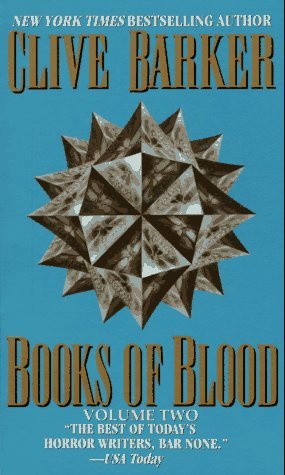 Maybe reading the first volume of Books of Blood desensitized me a bit, but it seemed like the second volume was a bit less shocking. Overall I still enjoyed the collection and each of the stories was interesting but not quite as memorable as the ones from the first volume... except for the last story - New Murders in the Rue Morgue... which was every bit as crazy and unexpected as one could hope for. It basically adds on to Poe's classic story as a sorta sequel and adds a new layer to it. I'll give volume 2 of Clive Barker's Books of Blood a B.
Thursday, April 9, 2015
Mystery Book # 7 - The Moonstone by Wilkie Collins
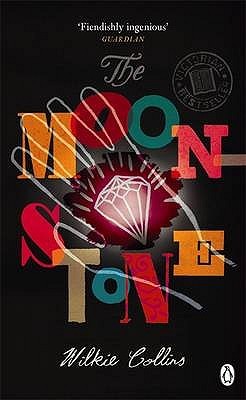 The Moonstone, by Wilkie Collins, is one of the first real "mystery" novels of its time. It has a bunch of the things that show up in the mystery genre - someone playing detective, a bunch of suspects, and an explanation at the end of how the crime was committed. The mystery here is the disappearance of a giant diamond that a young English woman receives as an inheritance on her 18th birthday. Is it one of her two possible suitors? A maid? A visiting doctor? Or even a group of Indians that worship the stone?
 The story is told from different points of view, so having different narrators as the story went along kept it interesting. Overall I really enjoyed it and was surprised how modern of a book it felt for something over 160 years old. My only minor quibble is that it is a bit longer than it really needs to be. I highly recommend it for anyone that likes nineteenth century English literature or a good mystery. A.
Subscribe to:
Posts (Atom)